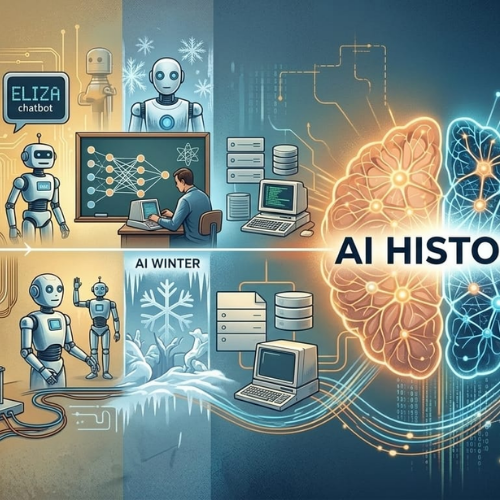
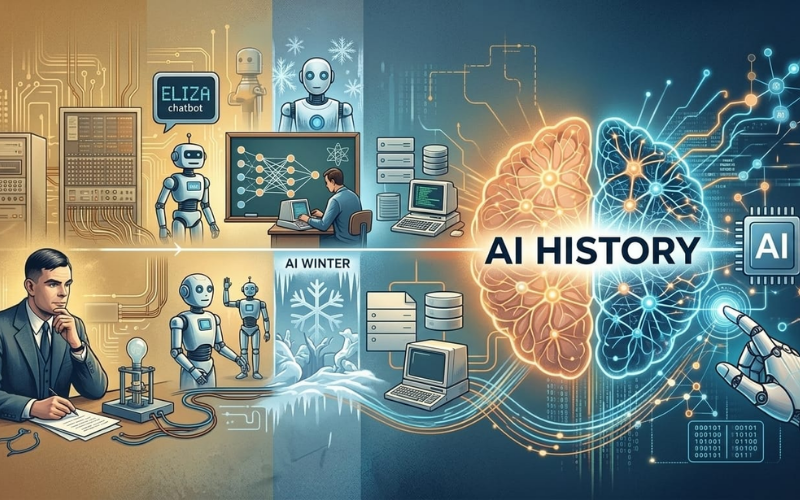
Artificial Intelligence (AI), once confined to the realm of science fiction, has evolved into a transformative force across disciplines. Its conceptual roots can be traced back to the early 20th century. Alan Turing, a pioneering British mathematician, laid the theoretical foundation in the 1930s by proposing the Turing Machine, capable of simulating any computation. In1950, he introduced the Turing Test, a method for evaluating whether a machine could exhibit intelligent behaviour indistinguishable from a human.
The formal establishment of AI as an academic field occurred in 1955, when John McCarthy coined the term “Artificial Intelligence” and later developed LISP, one of the first programming languages used extensively in AI research. Early research focused on symbolic reasoning and problem-solving, but progress was limited by computational constraints.
Significant breakthroughs occurred in the 1990s. The emergence of deep learning
algorithms, although initially constrained by limited hardware, set the stage for future advancements. A landmark moment came in 1997, when IBM’s Deep Blue defeated world chess champion Garry Kasparov, demonstrating AI’s potential in complex strategic environments.
The expansion of the internet in the late 1990s and early 2000s provided access to large datasets and improved computational resources, fuelling the growth of machine learning (ML). AI systems began powering search engines, spam filters, and digital advertising, enhancing user experience and business efficiency.
The 2010s marked the deep learning revolution, driven by increased processing power (particularly GPUs) and the availability of big data. This period saw rapid advancements in natural language processing (NLP), autonomous vehicles, voice assistants, and image recognition. Traditional logic-based approaches gradually gave way to data-driven statistical inference, enabling machines to learn from patterns rather than predefined rules. In the 2020s, AI achieved milestones once considered science fiction. Deep learning models began to outperform humans in tasks like image classification and protein folding.
DeepMind’s AlphaFold, in particular, solved the complex biological challenge of predicting protein structures—an achievement that had eluded scientists for decades.
From theoretical constructs to real-world applications, AI’s evolution reflects a profound technological journey. Its history highlights the interplay between algorithmic innovation, data availability, and computing power—factors that continue to shape AI’s trajectory in the
21st century (Evolution and Future of AI).